

Since my recent YouTube video discussing our sail design processes, I’ve received a lot of questions about the software we use—specifically mVPP and mRace. It’s time to pull back the curtain and show you how we’ve taken sail performance analysis to a completely different level.
The Origin: Perfectionism & Foiling Boats
When I started designing sails, I knew I wanted to push the boundaries of analysis. The turning point came with the appearance of DS sails and our work with foiling A-Cats and Phantoms. I needed a VPP (Velocity Prediction Program) that could accurately handle these complex, high-speed flying boats. Existing solutions were either too expensive or couldn’t handle foiling dynamics properly.
Driven by perfectionism, we decided to build our own. That’s how mVPP was born. Initially developed for an F18 project, the results immediately proved we were on the right track. mVPP solves the aero-hydro force equilibrium iteratively, returning predicted boat speed, heel angle, and leeway angle.
The Evolution: From Spreadsheets to 6DOF Dynamics
Later, while working on adapting the AC45 to a soft rig, I realized we needed more than just straight-line speeds. We needed to simulate realistic races under varying wind conditions. This is where mRace came in.
For years, mRace was a purely numerical tool—just numbers on a black terminal screen or exported to Excel. But we didn’t stop there. We gave it a powerful frontend and fully integrated it with mVPP. Today, mRace is a full 6DOF (surge, sway, heave, roll, pitch, yaw) simulation module. It captures what standard polars miss: tacking and gybing transition costs, roll-induced acceleration, and pitch stability in waves. We can simulate hulls, hydrodynamic drag, wave modeling, and maneuver losses all at once.
Where We Are Today: Grand Prix Ready
Our latest updates have turned these tools into an absolute powerhouse. We now fully support:
-
Foiling multihulls and semi-foiling monohulls.
-
Canting keels and variable cant angle foils (like the AC40s and AC75s).
-
Non-foiling stabilizers, DSS wings, and crew weight/position optimization.
-
Direct data imports from ORC certificates and Azure Flow for seamless comparisons.
The Future is Real-Time: SailSmart OW (On-Water)
We’ve now taken this ecosystem a step further by connecting it to SailSmart OW, an integrated on-water app. Imagine this: you take a photo of your sail on the water, and the system extracts the real 3D flying shape. Within a second, it compares your current setup to the mVPP predictions.
Instead of guessing if a sail is “too flat,” the system provides exact numbers and physical trim advice—down to telling you to “Pull -17% Cunningham” to achieve the optimal shape. It allows us to see immediately if the sail is performing as designed, eliminating guesswork entirely.
It is working really nicely on our test boat, and we will soon start testing this function with our pro team members.
Trickle-Down Technology for Every Sailor
Behind the scenes, feeding this system requires heavy lifting. We use an intensive CFD (Computational Fluid Dynamics) pipeline to generate high-fidelity synthetic data. Running these computations requires serious hardware and time, making direct CFD analysis something we primarily reserve for Grand Prix and professional racing classes.
However, here is the magic: our machine learning model trains on every single session and all this advanced CFD data. This means the neural network is constantly getting smarter. While a hobby racer or cruiser might not need a dedicated CFD analysis, the sails they buy from us are directly benefiting from the massive dataset generated by the pros. The technology trickles down, resulting in faster, more efficient sails for everyone.
Some pictures below of a demo configuration:
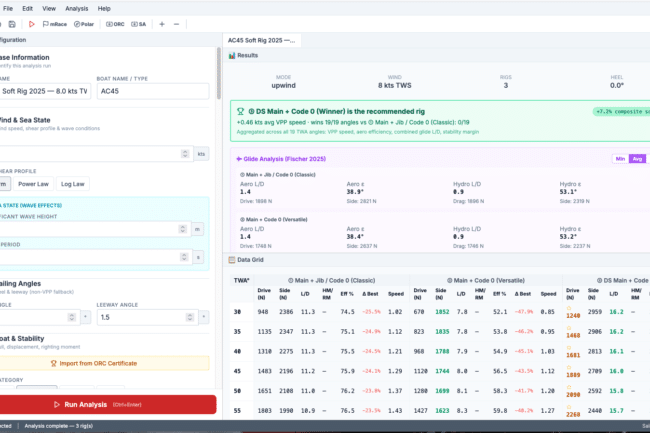
mVPP
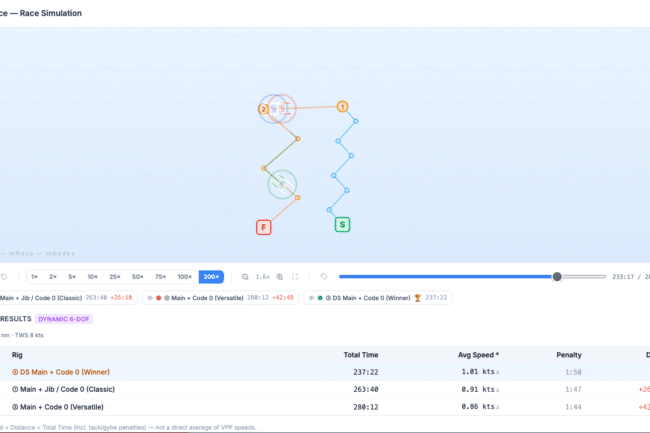
mRace
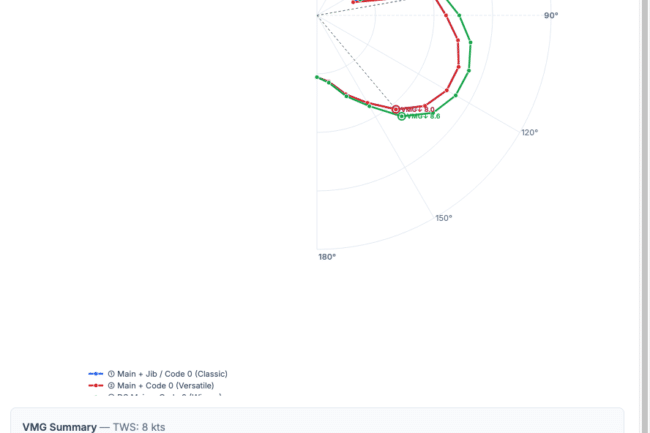
mVPP polar


